

By Asuquo Cletus
CALABAR – The Cross River State Government has intensified efforts to strengthen its data management system with the training of 30 statisticians and Planning, Research and Statistics (PRS) officers on data analysis, management, and policy reporting.
The programme is part of broader reforms aimed at harmonising statistical reporting across Ministries, Departments and Agencies (MDAs), while entrenching a culture of evidence-based governance in the state.
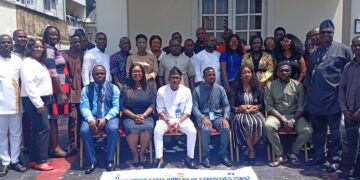
The five-day capacity-building workshop, organised by the Cross River State Bureau of Statistics in collaboration with United Nations Population Fund, is held in Calabar from 20th to 24th April 2026. The training, themed “Data Management, Analysis and Reporting Using the Statistical Package for the Social Sciences (SPSS)”, is designed to equip newly recruited statistical personnel with modern analytical tools and reporting techniques.
Speaking at the event, the State Statistician-General, Akedoh Okoi, emphasised the growing importance of modern data systems in governance. She noted that statistics must not only be accurate but also presented in formats that are accessible to policymakers and the general public.
According to her, effective data analysis goes beyond collection, requiring proper cleaning, disaggregation, and interpretation to support strategic planning and targeted interventions.
“Data reporting and analysis are very key for statisticians because when you get your data in its raw state, you need to clean it and present it in a manner that can be used for policy and development planning,” she said.
Okoi explained that improved statistical reporting would enable the government to identify priority areas across local government councils, particularly in critical sectors such as agriculture, health, and social development.
She further disclosed that the recent recruitment of statisticians was part of deliberate efforts to reposition the state’s data architecture.
She also commended United Nations Population Fund for its sustained partnership, particularly its support in producing the 2024 Statistical Yearbook and advancing capacity-building initiatives in the state.
In his remarks, the UNFPA Head of Sub-Office and Programme Coordinator, Andrew Kirima, described the training as a critical step towards strengthening evidence-based planning and policy formulation.
He stressed that reliable and high-quality data remain central to sustainable development outcomes, noting that statisticians play a pivotal role in translating raw figures into actionable insights.
“Government plans and programmes are only as strong as the data behind them. This training will help participants move from raw numbers to meaningful insights that inform policy,” he said.
Also speaking, the Vice Chairman and Chief Executive Officer of the State Planning Commission, represented by Kingsley Ndem, underscored the indispensability of credible statistics in governance.
He urged participants to approach the training with commitment, noting that the knowledge acquired would be instrumental in improving planning processes and service delivery across MDAs.
The workshop, held at Adsuit Hotel, features intensive practical sessions using the Statistical Package for the Social Sciences (SPSS). Participants are being trained on data cleaning, descriptive and inferential analysis, interpretation of statistical outputs, and the development of policy-friendly reports.
The initiative marks another significant step by the Cross River State Government towards institutionalising data-driven decision-making and strengthening public sector performance through accurate and timely statistical reporting.
