

By Daniel Agbor
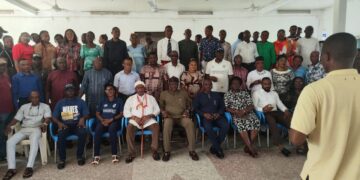
The Executive Chairman of Akamkpa Local Government Council, Hon. Amb. (Ophot) Felix Akposi KSJI, has reaffirmed his administration’s commitment to strengthening land governance and driving sustainable development, declaring that progress in the area is anchored on collective responsibility and faith. Speaking during an engagement session with stakeholders and consultants on Tuesday, the 7th of April, 2026 at the local government headquarters, the Chairman expressed gratitude to God for the success of the meeting, noting firmly that “with God, all things are possible.”
He commended the assessment team for selecting Akamkpa as a focal point for information gathering and the development of a scalable model for the state. Emphasising the council’s openness to growth, he stated that Akamkpa remains receptive to investment and investors, stressing that the foundations being laid today would shape the “new Akamkpa” envisioned by his administration. According to him, achieving this vision requires unity of purpose, shared interest, and sustained collaboration.
On land administration, the Chairman clarified that the issuance of customary land titles remains the statutory responsibility of the local government council. He observed that in the past, limited awareness resulted in low interest in obtaining such documents, but noted a significant shift in recent times.
To strengthen local structures, he has constituted the Land Allocation and Advisory Committee, a six-member body tasked with overseeing land-related processes. He appreciated the presence of the traditional institution, noting its critical role in maintaining order and trust in land matters. Addressing concerns on land valuation, he explained that applicable percentages are determined by proximity to access roads.
He therefore called for intensified advocacy to encourage landowners to regularise their holdings. He further explained that once payments are made at the local government level, there is no requirement for duplication at the state level.
In his remarks, the Lead Consultant for the FAO GEF7 FOLUR-IP Nigeria Project, Prof. Damian Agom, lauded the Chairman’s proactive leadership and hands-on approach in creating an enabling environment for seamless access to customary land titles.
He reiterated that only the Chairman is vested with the authority to sign customary rights of occupancy, a process that begins with proper assessment before issuance of land title documents.
Prof. Agom also disclosed that Akamkpa is one of eight local government areas selected for the exercise, with outcomes expected to inform a statewide model.
He commended the Land Allocation and Advisory Committee for its diligence and professionalism, particularly in inspection and documentation processes.
Prof. Agom explained that the project is designed to promote Integrated Landscape Management and Sustainable Food Systems across the Niger Delta region. He noted with satisfaction that Akamkpa currently stands out among the assessed local government areas, attributing this to the structured coordination and effective systems put in place. He further observed that the area records minimal cases of communal land disputes, a development he described as a strong indicator of functional governance and community trust.
The Head of Local Government Administration, Dr. Mrs. Obal Esang, expressed appreciation to the consultant for what she described as a transparent and insightful engagement. She assured stakeholders that all recommendations put forward would be carefully implemented to address potential gaps and strengthen existing frameworks, noting that the proposals were both practical and forward-looking.
Representing the Paramount Ruler of Akamkpa, HRM Amb. Dr. (Ophot) Agbor Ewa Ebani, the Clan Head of Ekerebe North, HRH Ntufam Paul Okon Ntui, reaffirmed the traditional institution’s role in managing land matters with fairness and integrity. He explained that the effectiveness of their dispute resolution mechanisms has significantly reduced reliance on formal courts, thereby fostering peace and stability across communities.
Despite the progress recorded, stakeholders identified key challenges, particularly in record keeping and public awareness. It was noted that the transition of customary land administration from the state to the local government is still evolving, with land acquisition processes presenting initial difficulties that require continuous sensitisation and adaptation.
To address these concerns, recommendations were advanced, including the engagement of GIS specialists, surveyors, and social workers, as well as deeper collaboration with the traditional institution. Emphasis was also placed on improving record management systems, strengthening capacity through training, enhancing public awareness campaigns, appointment of a local government desk officer and establishing effective grievance redress mechanisms.
The session concluded on a forward-looking note, with the FOLUR team affirming its commitment to sustained engagement through additional data gathering channels, aimed at broadening participation and refining outcomes for long-term impact.
