

By Daniel Agbor
Sunday, 8th March 2026, a date now etched in the global calendar as International Women’s Day, the Akpabuyo Local Government Council Headquarters stirred with uncommon colour and purpose. Women from diverse enterprise groups under the International Fund for Agricultural Development Livelihood Intervention Family Enterprise for the Niger Delta (IFAD LIFE-ND), Cross River State Office, converged with songs, poise, and the quiet confidence of women who know their worth.
The occasion was at once a celebration and a clarion call, a testament that the arc of development bends, however slowly, towards the woman who toils in the field, feeds the family, and holds the community together. Under the theme “Give to Gain,” this year’s global observance found vivid expression in the mangrove heartland of the Niger Delta.
Dona Nobis Pacem: Grant Us Our Share
Representing the State Coordinator, Mr. Innocent Ogbin, it was Mrs. Ewor Mike, the State Rural Institution Gender and Youth Officer, who stepped to the podium, her voice carrying the warmth of solidarity and the weight of institutional commitment.
She began by thanking the women, not in the perfunctory official manner, but with genuine acknowledgment of the sacrifices embedded in their attendance: markets left unattended, farms momentarily forsaken, children briefly entrusted to neighbours, all in the name of community and shared purpose.
“The theme of this year’s International Women’s Day Celebration, “Give to Gain,” truly speaks to us,” she told the gathering. Reflecting on messages received from the National Project Coordinator and State Project Coordinator, she noted that the theme amplified the call for deeper commitment and an uncompromising dignity in all that the women do.
Particularly evocative was her elucidation of the symbolic colours of this year’s celebration, white, green, and purple. These were not mere aesthetic choices, she explained, but visual declarations: white for peace and purity, green for fertility and productivity, purple for dignity. “Put these together,” she concluded with characteristic simplicity, “and the result speaks for itself.”
Scientia Est Potentia, Knowledge Is Power
It was left to Mr. Hillary Ekpe, ICT expert and anchor for the ICT 4 Development initiative, to give the day its intellectual scaffolding. His lecture was a masterclass in applied thinking, at once grounded in the realities of rural womanhood and visionary in its aspirations.
Ekpe implored the women to transcend what he called the “primordial nuances”, the deeply ingrained, often self-limiting beliefs and social conventions that have long circumscribed the lives of women in the Niger Delta. His charge was not a rebuke but an invitation: to trade the via negativa, the path defined by what one cannot do, for a life of deliberate partnership and egalitarian purpose.
He also advocated for what he termed a “discursive methodology” in communication, the art of dialogue over monologue, of listening as much as speaking, of building consensus through respectful exchange. In a region where women’s voices have often been the loudest in the market but the quietest in the council hall, the counsel carried particular resonance.
His address reached its most powerful register, however, when he opened the floor for testimonials. One after another, women, enterprise members from across Akpabuyo, rose to speak, notably Mrs. Patience Nakanda and Offiong Edem Bassey. They spoke of the life changing impacts of the IFAD LIFE ND Project, business management and orientation, accessed to infrastructure, training, of businesses rebuilt, of children now in school. They spoke of lives before IFAD LIFE-ND and lives after, the contrast so stark it needed no embellishment.
Vox Feminarum: The Voice of the Women.
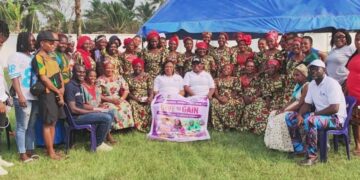
The high point of the event was an outpouring of cultural expression, songs rendered with abandon, dance movements that told stories no English sentence could fully capture, and the kind of communal joy that only emerges when people feel truly seen. The celebrations climaxed with a group photograph, the assembled women standing in their finery, a living tableau of the theme they had gathered to honour.
In the truest sense of the day’s theme, these women had given, of their time, their energy, their stories, and in the giving, they had collectively gained: solidarity, visibility, and renewed resolve.
